
One of the most important jobs in the country
Photo Credit: WWF
One of the most important jobs in the country is that of a catchment management official. These are the people mandated to manage and monitor South Africa’s threatened water resources and its 22 strategic water source areas (SWSAs), which collectively produce over 50% of our national water supply.
It’s a role that demands high-level skills and specialist training – exactly what a 3-year project co- funded by the WWF Nedbank Green Trust and the JRS Foundation aims to provide. Launched in May 2025, the project is titled ‘Empowering mandated authorities to manage South Africa’s threatened water’, and is led by Dr Sharon Pollard of the Freshwater Research Centre (FRC) in Kommetjie, Cape Town. Dr Pollard holds a doctorate in freshwater ecology and brings extensive experience in water governance, -management and -sustainability.
South Africa’s water resources are managed by dividing the country into 6 Water Management Areas (WMAs). Each WMA is overseen by a Catchment Management Agency (CMA).



‘Strengthening the capabilities of catchment management officials is essential for safeguarding South Africa’s Strategic Water Source Areas,’ says Poovi Pillay, Executive Head of Corporate Social Impact (CSI) at Nedbank. ‘As CMAs become better equipped to monitor and manage flows, water quality and ecological health, they reinforce the resilience of entire catchments – from source to downstream users. Ultimately, this investment empowers mandated authorities to protect this scarce resource.’
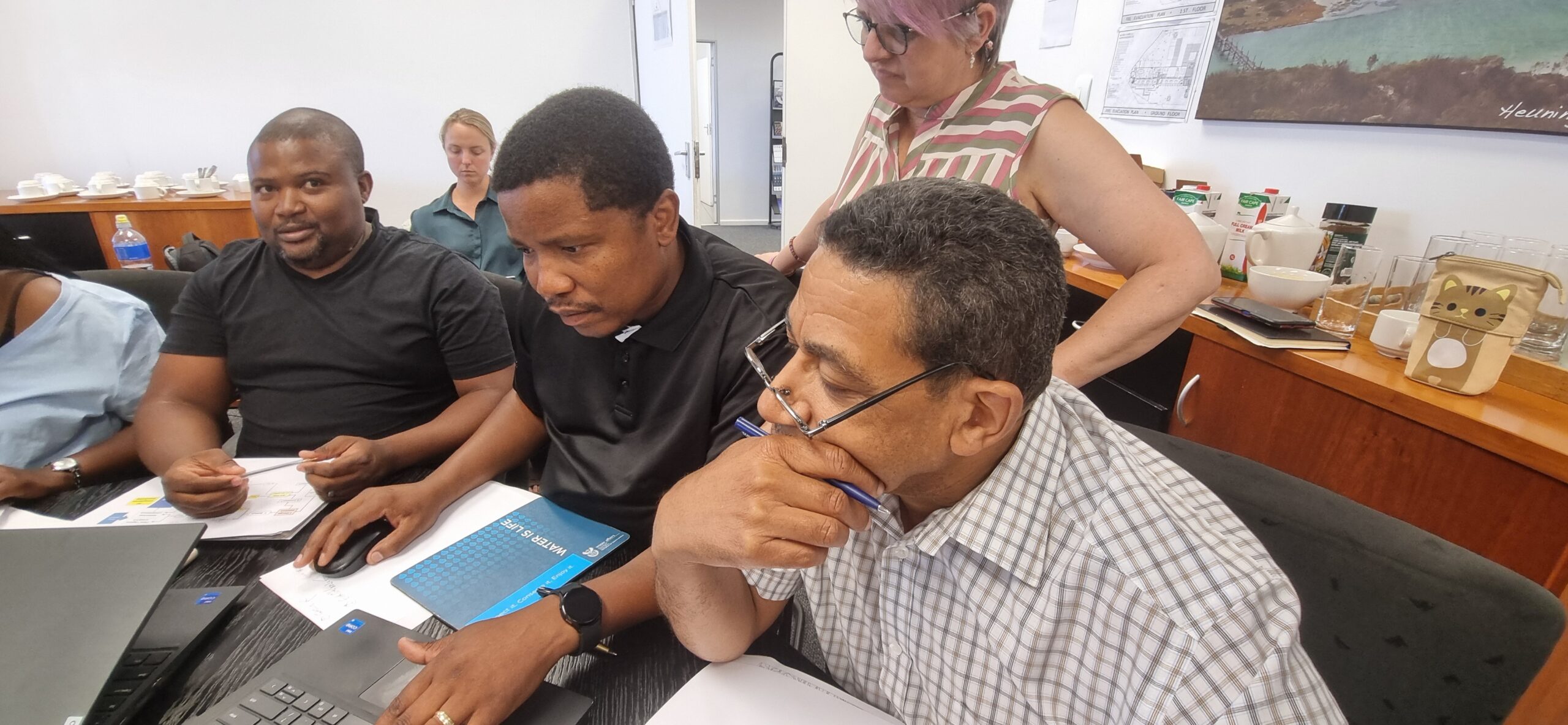
The first training workshop in water source protection took place in Worcester in December 2025 at the Breede-Olifants CMA offices. About 25 CMA employees and other mandated authorities attended, with a focus on the western part of the Breede-Olifants WMA, and the Gouritz and Garden Route coastal rivers. In January 2026, a second workshop was held in George for a similar group of CMA employees and partners, including the Department of Water and Sanitation (DWS), Garden Route SANParks and CapeNature, focusing again on the Breede-Olifants WMA.
‘The Breede-Olifants WMA is home to several Strategic Water Source Areas,’ says Pollard. ‘We’re developing capacity and building key competencies among mandated employees and partners.’ CMA employees bring a range of qualifications – from honours-level freshwater ecologists to SASS- trained aquatic biomonitoring practitioners and auxiliary officers with technical diplomas and water quality training.
‘The CMAs are understaffed, and while many are doing their best to monitor water quality and assess ecological health, they need additional support to ensure compliance with the gazetted benchmarks for the Ecological Reserve and Resource Quality Objectives,’ Pollard explains. South Africa’s National Water Act includes a water resource protection policy that covers rivers, wetlands and estuaries. This protection is enacted through the Ecological Reserve – a legally defined quantity and quality of water that must be maintained to ensure the long-term sustainability of our rivers and catchments.
‘Determining the Ecological Reserve is a detailed process,’ Pollard notes. ‘It involves understanding the natural seasonal flow regime, current water uses – including agriculture and industry – and determining what each catchment’s reserve should be.’
In several catchments, water is already over-allocated, making it extremely challenging to return to levels that meet Ecological Reserve requirements. Water users are often reluctant to reduce their allocations.
Resource Quality Objectives (RQOs) set benchmarks for every river, including flow and water quality, and are gazetted as policy requirements. CMAs are responsible for ensuring compliance.
‘The problem is the large gap between what is gazetted and what is implemented,’ says Pollard. ‘Many CMA employees need additional support and intensive training to apply these requirements effectively.
‘I previously worked with the Nkomati CMA, where we collaborated with SANParks and other partners to develop processes and methodologies for monitoring and managing both the Ecological Reserve and RQOs. A key part of the success was bringing everyone on board so they knew what to do. Without this, employees can feel overwhelmed or even disincentivised.’
The 3-year Breede-Gouritz project includes 3 core capacity development modules:
- Addressing decreasing water quantity – a major concern. The Flow Compliance Monitoring module builds skills in flow measurement, accessing and interpreting river-, wetland- and estuary data, and interpreting gazetted requirements. Crucially, data is compared with each site’s established Ecological Reserve values to assess compliance.
- Monitoring and reporting on water quality, addressing contaminants of concern such as E.coli from wastewater treatment plants, as well as herbicides, pesticides, industrial compounds and heavy metals – all of which pose risks to ecosystems, people and animals.
- Assessing ecological health, focusing on how aquatic biota respond to changes in flow and water quality – a critical component of compliance monitoring.
‘For all the work, we apply a systems approach that recognises social, economic and political realities alongside technical requirements,’ Pollard explains. ‘Beyond monitoring and technological skills, it requires engaging businesses and communities. This can be a conflictual or empowering space, demanding strong management skills.’
Lessons from the Breede-Olifants work will help inform similar capacity development modules for 4 additional Catchment Management Agencies, building capacity countrywide.